










Pilgrim stories · Via de la Plata

Five days in Extremadura: wide horizons, storks and a Camino almost all to myself

Translated from Deutsch · See original

Story by the team

From Zafra through Mérida to Cáceres on the Vía de la Plata, alone, in April. If you are looking for a Camino without crowds, you will find it here: cork oaks, Roman roads, 36-kilometre stages, monks who welcome pilgrims, and a silence you no longer find in Germany.

Elisabeth Hartmann April 2024 · 5 days · 135 km

Day 1 · 8 April

Zafra – Villafranca de los Barros: vineyards in the morning light

I did not meet a soul among the vines for an hour. Just larks. I laughed out loud with happiness, and no one heard me.

I am fifty-eight, a teacher in Freiburg, and I have been walking alone for ten years. I have done the Francés twice, and the second time, in Sarria, I decided I had had enough of queues of people. A colleague said: «Then try the Vía de la Plata, but take water.» She was right on both counts.

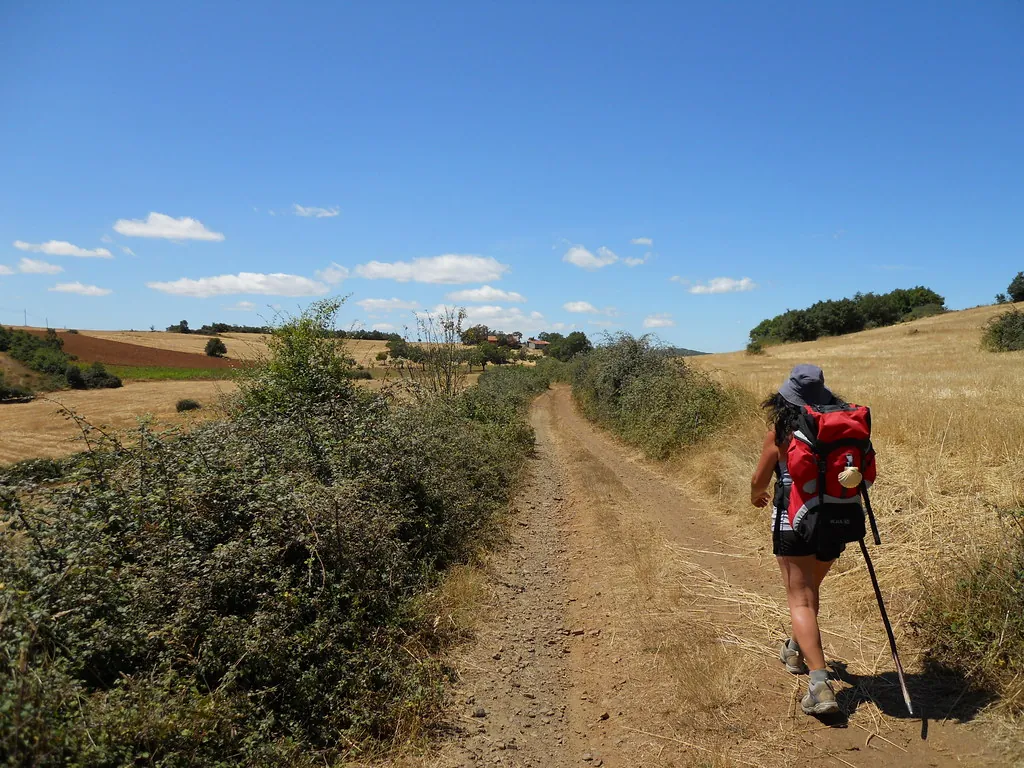
Zafra is a gem and the ideal starting point: Plaza Grande, Plaza Chica, a breakfast of toast, olive oil and grated tomato that I have since recreated at home every morning. The route heads straight out of town, through vineyards and olive groves, and within twenty minutes you are alone. Truly alone: an hour with nothing but larks, a tractor in the distance, the wind in the vines. I laughed out loud with happiness, and no one heard me.

Villafranca

Villafranca de los Barros lives off wine, and the locals greet every pilgrim because they see so few. The woman who ran the guesthouse gave me a piece of cheese for dinner and asked whether I was not afraid, being so alone. I said no, only of tomorrow's stage. She laughed and packed a second litre of water for me.

Distance
19.8 km
Mood
Radiant
Slept at:
Pension in Villafranca

Day 2 · 9 April

Villafranca – Torremejía: the long straight stretch

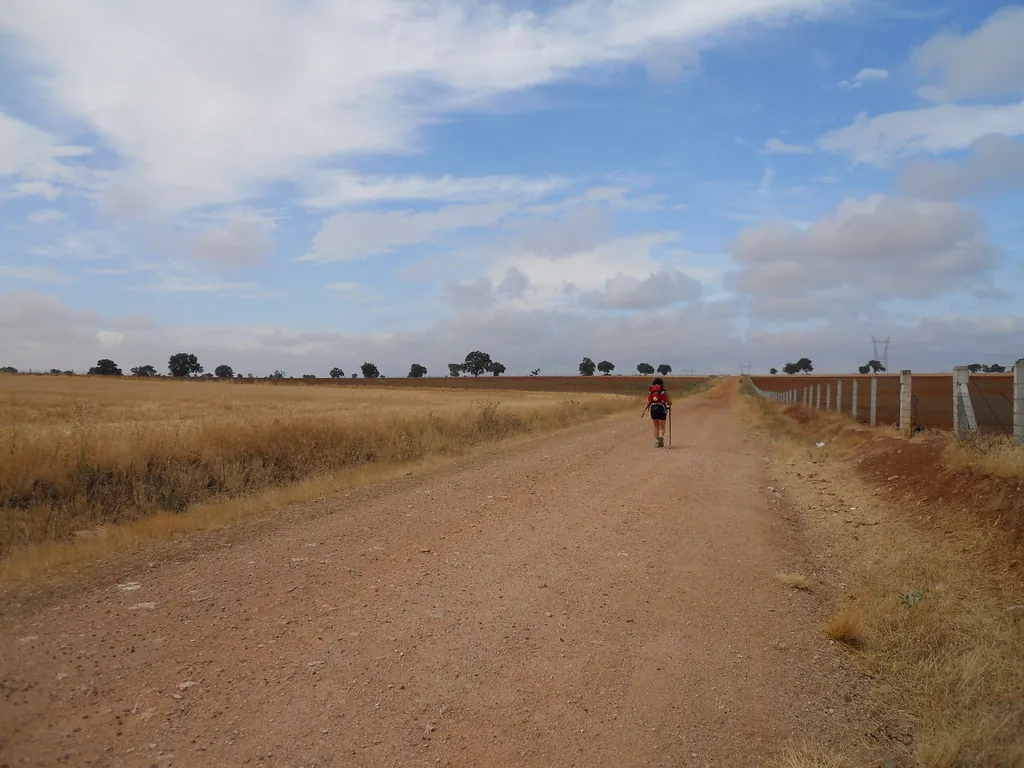
27 kilometres, no village, no tree. Just the path and me. A kind of silence you no longer find in Germany.

This is the stage everyone warns you about: nowhere to get supplies, hardly any shade, a perfectly straight farm track through vineyards and grain fields, with Torremejía somewhere at the end. Two litres of water are essential; three are better. I set off at half past six, with a head torch, and the first two hours were the most beautiful of the entire Camino.

And yet: one of my favourite stages ever. The horizon is everywhere, storks perch on every electricity pole and clatter their bills as you pass, and eventually you stop thinking about anything at all. Along the way I saw just one car and a shepherd who waved at me with his stick.

Torremejía

Torremejía has a bar where you are welcomed like a hero. Without my ordering anything, the owner put a beer and a plate of olives in front of me and said they were on the house because I had made it through the straight stretch. I was alone in the albergue. I left the door open and listened to the crickets.

Distance
26.7 km
Mood
Good
Slept at:
Albergue in Torremejía

Day 3 · 10 April

Torremejía – Mérida: Rome in Spain

Walking into Mérida across the Roman bridge over the Guadiana, backpack on, after sixty kilometres of countryside: goosebumps. I went back that evening just to see it.

A short stage, deliberately. Fifteen kilometres across flat land, then suddenly you are standing before the longest Roman bridge still in existence: sixty arches over the Guadiana, and you walk across it like the legionaries two thousand years ago, only with worse shoes.

Mérida deserves half a day, at least. The theatre, where performances are still held in summer, the amphitheatre, the Temple of Diana amid the houses, the museum, which you should not miss even on a rest day. I sat on the theatre steps, ate an ice cream and wondered why it had taken me so long to come here.

Practicalities

The pilgrim hostel is small; in spring it is better to book a hostal. I was lucky. That evening I went back to the bridge as the lights came on and spent a quarter of an hour simply looking. A pilgrim from Sevilla, the only one I met in five days, sat down beside me. We did not say a word. It was exactly right.

Distance
15.3 km
Mood
Radiant
Slept at:
Hostal im Zentrum von Mérida

Day 4 · 11 April

Mérida – Alcuéscar: the queen stage

The Proserpina reservoir at sunrise, and in the evening the monks in Alcuéscar, who welcome pilgrims without asking a single question.

Almost thirty-six kilometres. I set off at six, through the empty city in the dark, and at the Proserpina reservoir, built by the Romans, it was still cool and quiet. From Aljucén onwards it grew hot, really hot, and the route stretches through the dehesa, those open cork oak woodlands that offer more shade than you think, if you know where to walk.

At kilometre 28, for the first time on this Camino, I had doubts. My feet were burning, the water was warm, and Alcuéscar seemed no closer. I sat beneath a cork oak, took my shoes off and waited twenty minutes. Then I walked on, because there was nothing else to do. That is the whole wisdom of the Vía de la Plata.

The Casa de la Misericordia

In Alcuéscar, the Casa de la Misericordia welcomes pilgrims in exchange for a donation. The monks, who run a home there for people with disabilities, ask nothing and give everything: a bed, a shower, dinner with the residents. I sat beside a man who has lived there for thirty years and proudly showed me his room. It was the most moving hour of my journey, and I do not write that lightly.

Distance
35.9 km
Mood
Tired
Slept at:
Casa de la Misericordia, Alcuéscar

Day 5 · 12 April

Alcuéscar – Cáceres: arrival in the city of stone

The old town of Cáceres in the evening light, all stone, all stillness. I sat on the steps of the Plaza Mayor and looked back over five days.

The longest stage, partly along the original Roman road, with milestones at the roadside that you can touch. I set off early, with the monk's blessing at the door, and planned breaks in Aldea del Cano and Valdesalor, as the woman at the guesthouse in Villafranca had advised. Both are small villages with a bar, a church and storks on the church tower.

The last ten kilometres to Cáceres are flat and long, and the city announces itself well before you arrive. I did the sums as I walked: five days, one hundred and thirty-five kilometres, two pilgrims met, roughly four hundred storks. I resolved not to tell anyone who would not understand.

Cáceres

Cáceres is the most beautiful ending you could wish for: an old town made entirely of stone, palaces, towers, narrow streets that fall quiet in the evening. I sat on the steps of the Plaza Mayor, my shoes beside me, and looked back over five days. If you only have a week: these five days are the Vía de la Plata in its purest form. If you have more time, carry on to Salamanca. I will be back in October, when the storks have returned.

Distance
37.4 km
Mood
Radiant
Slept at:
Pension in der Altstadt von Cáceres