










Pilgrim stories · Portuguese Way

From Tui to Santiago with my mum: five days we will never forget

Translated from Português · See original

Story by the team

The last five days of the Portuguese Camino, from Tui to Santiago, with my 68-year-old mum, who had never slept in a pilgrim hostel. Short stages, long conversations, Galician woods, oysters in Arcade, fine rain and an arrival that still makes me cry.

Inês Machado April 2025 · 5 days · 115 km

Day 1 · 14 April

Tui – Redondela: crossing the Minho and setting off

My mum stopped halfway across the international bridge, looked at the Minho and said, “So this is it.” Yes, Mum, this is it.

It was her idea. At sixty-eight, widowed for two years, my mum told me one Tuesday, while washing the dishes, that she wanted to walk the Camino de Santiago before her knees stopped keeping up. I was thirty-nine, had a job that kept me awake at night and no desire to walk anywhere. I said yes because you do not say no to your mum.

We left Valença at sunrise, walked across the international bridge over the Minho and she stopped halfway, one foot in Portugal and the other in Spain, looking at the river. “So this is it.” We had our pilgrim passports stamped at Tui cathedral, which looks like a fortress, and ate our first chorizo bread of the trip sitting on the steps.

O Porriño and the river Louro

After Tui, the Camino passes through an ugly industrial area, but a detour along the river Louro, between poplars and mills, avoids almost all of it. Follow the hand-painted yellow arrows, not the official ones. In Mos, a woman gave us water and told my mum she was very brave. Mum replied that my dad was the brave one, that he had died without complaining, and we carried on.

Redondela came slowly, with its iron viaducts. The stage is much too long for the first day; if you can, split it in two and stay in O Porriño. We did not know.

Distance
31.5 km
Mood
Good
Slept at:
Albergue municipal de Redondela

Day 2 · 15 April

Redondela – Pontevedra: the estuary and the scallop shells

In Arcade we ate oysters at eleven in the morning. My mum had never tried them. Now she wants to go back just for that.

A lovely, peaceful stage, the first where our bodies already knew what they were doing. The climb out of Redondela overlooks the Vigo estuary, with the mussel rafts floating like dots on a sheet of paper, and the woods on the way to Arcade smell of wet eucalyptus.

In Arcade, the oyster capital, we ate a dozen at eleven in the morning, in a bar where the owner opened them with a knife and a smile. My mum had never tried oysters. She pulled one face, then another, and ordered six more. Now she says she wants to return to Galicia just for that, and I believe her.

The bridge at Sampaio

The medieval bridge at Sampaio, where the Galicians stopped the French in 1809, is the place for a photo. Then the path rises and falls through the woods to Pontevedra, with a Roman road still visible in places. On that climb, my mum told me that my dad had promised her they would walk the Camino when they retired, and they had never got round to going. She said nothing else for an hour. Neither did I.

Pontevedra is perfect for a free afternoon: squares named after fruit and vegetables, the scallop-shaped Peregrina church and a leisurely dinner of Galician-style octopus. We slept in a guesthouse overlooking a square where a band was playing.

Distance
19.6 km
Mood
Radiant
Slept at:
Pensão no centro de Pontevedra

Day 3 · 16 April

Pontevedra – Caldas de Reis: woods and warm waters

Arriving in Caldas in the rain and dipping our feet in the hot-water fountain on the main street. My mum said it was the best moment of the Camino. I disagree, but I understand.

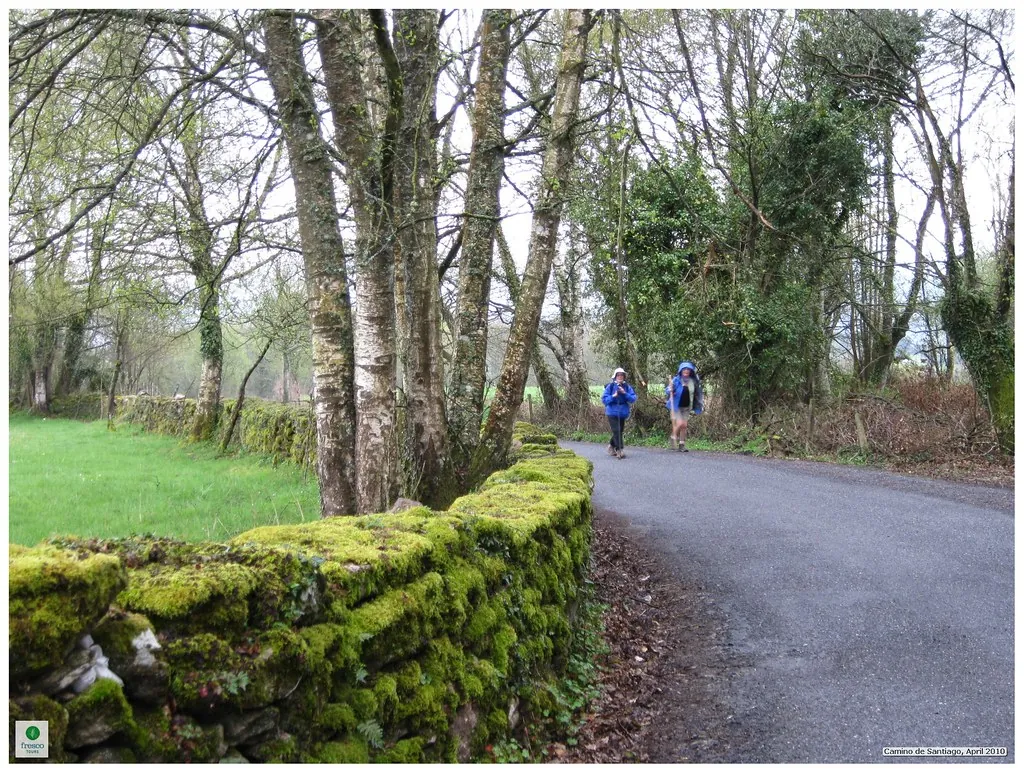
Out across the Burgo bridge and on through eucalyptus trees, vineyards and villages where the cockerel crows at the wrong time. Fine Galician rain all morning, the kind that does not get you wet, just soaks you through. My mum, who had carried a folding umbrella all the way from Portugal, was the only dry person in twenty kilometres of Camino, and was very proud of it.

In Tibo we stopped at a bar where a man was playing Galician bagpipes for the pilgrims, and my mum, who has not danced since my sister’s wedding, took a couple of steps with him. I have the video. I am not going to post it.

Caldas de Reis

Caldas de Reis is a spa town: there is an outdoor hot-water fountain on the main street where pilgrims dip their feet after the day’s walk. We arrived soaking wet, took off our shoes and spent twenty minutes with our feet in the water, watching the rain fall. My mum said it was the best moment of the Camino. I disagree, the best was on the last day, but I completely understand.

Bring sandals and a little time to spare. And have dinner at the restaurant beside the river Umia, which makes a Galician broth my mum is still trying to copy.

Distance
21.1 km
Mood
Good
Slept at:
Albergue em Caldas de Reis

Day 4 · 17 April

Caldas de Reis – Padrón: the silent stage

On the climb after Carracedo we did not speak for an hour. We did not need to. Thirty years of conversations fit into a silence like that.

An easy stage through the Valga woods, past the chapel of Santa Mariña and down into the Ulla valley. It was the day my mum stopped asking how many kilometres were left. She walked ahead, using her closed umbrella as a walking stick, quietly singing fado songs I had no idea she knew.

On the climb after Carracedo we did not speak for an hour. We did not need to. There I realised that thirty years of conversations, the good ones and the bad, fit into a silence like that, and that this was why she wanted to walk the Camino: so we could be quiet together, with no house to clean, no phone, nobody calling for us.

Padrón

Padrón appears with its church, the pedrón (the stone where, according to legend, they tied up the boat that brought the Apostle’s body) and the memory of Rosalía de Castro. We had Padrón peppers for dinner, of course. Some are hot, some are not. Mum got the hot one and laughed with tears in her eyes, and I do not know whether it was the pepper.

Distance
18.6 km
Mood
Good
Slept at:
Pensão em Padrón

Day 5 · 18 April

Padrón – Santiago: the arrival

In the Praza do Obradoiro my mum hugged me and said, “Thank you for bringing me.” She was the one who brought me.

The last stage, the longest one we walked and the easiest. We left Padrón at seven, passed A Escravitude and its Baroque church, Teo, the oak woods of Faramello and then O Milladoiro, where Santiago begins to appear as buildings and roundabouts. And suddenly, from a rise, the cathedral towers in the distance. My mum stopped and crossed herself. I had never seen her do that.

The last few kilometres are through the city, nothing special, and it does not matter. We came in through Porta Faxeira, walked down the rúa do Franco, full of people and the smell of octopus, and passed under the arch of the Pazo de Xelmírez with a bagpiper playing. My mum was already crying before she saw the square.

The Praza do Obradoiro

We sat on the ground, like everyone else, with our backs to the Hostal dos Reis Católicos, facing the cathedral. My mum hugged me and said, “Thank you for bringing me.” She was the one who brought me. We went to the pilgrims’ Mass, watched the botafumeiro swing through the air, and that night at the hotel she fell asleep looking at the photos on her phone, one by one, starting with the Tui bridge.

If you are thinking of walking the Camino with your parents, do it now. Five days are enough to change the way you look at each other. We have already arranged the next one: Porto to Tui, in spring.

Distance
24.3 km
Mood
Radiant
Slept at:
Hotel em Santiago, duas noites