The stage, step by step
Leaving A Coruña and the Ría do Burgo
The first few kilometres are pure city: pavements, roundabouts and industrial units before you reach the Ría do Burgo and cross towards Culleredo. Between km 2.4 and km 4.4 there is an initial climb of 77 m at 3.9%, enough to warm you up but nothing compared with what lies ahead. Make the most of the pharmacies and supermarkets around you: this is the last time you will see them during the stage.
Almeiras and Sigrás
Through Culleredo you reach Almeiras and its church, Iglesia de San Xiao, around km 11, after a gentle 82 m climb that starts at km 8.3. Soon afterwards you cross the A Xira bridge over the River Valiñas and reach Iglesia de Santiago de Sigrás. The surface begins to alternate between tarmac on local lanes and dirt sections restored from the old Camiño Real.
Cambre and the countryside towards Carral
Beyond Cambre, the landscape finally becomes rural: chestnut trees, villages where cattle graze and quiet paths. This is also where the profile starts to bite: 176 m of climbing between km 13.1 and km 17.9, followed by a 102 m descent to km 20.7 that can be deceptive, because you will have to regain everything you lose there. Santa María de Cambre is worth a ten-minute stop.
Sergude and the climb to Hospital de Bruma
Around km 20 you pass Albergue de Peregrinos de Sergude, in Carral. If you are short of energy or daylight, this is the place to consider splitting the stage. From km 23 onwards, things get serious: 392 m of climbing to km 28.7, with an average gradient of 6.9% and nowhere to stock up. The terrain then eases off, and the final kilometres descend gently to Bruma, ending at Capilla de San Lourenzo and Hospital de Bruma.
What to see on stage 1
Iglesia de Santiago de A Coruña
It stands in the historic centre and is the natural starting point for the stage. It retains a Gothic 15th-century west façade, with the Apostle on horseback in the tympanum—the image that best explains why this route begins here rather than elsewhere in the city.
Iglesia de San Xiao de Almeiras
It appears around km 11, once you have left the worst of the urban tarmac behind. It is Romanesque and houses the statue of the Caballero de Almeiras, associated with a 15th-century tomb discovered inside the church itself.
Iglesia de Santiago de Sigrás
This 12th-century Romanesque church has been rebuilt several times since the 15th century. It is part of a larger site with an unusual well and a rectory built on the site of a former pilgrim hospital, so people with rucksacks have been passing through here for centuries.
Iglesia de Santa María de Cambre
This is the finest sight of the whole day. It is pure 12th-century Romanesque architecture, with a Latin-cross plan, three naves and an ambulatory with five semicircular apses—the only surviving part of the 9th-century monastery destroyed in 1182. It served as a pilgrim hospital, particularly for those arriving from the Netherlands.
Capilla de San Lourenzo de Bruma
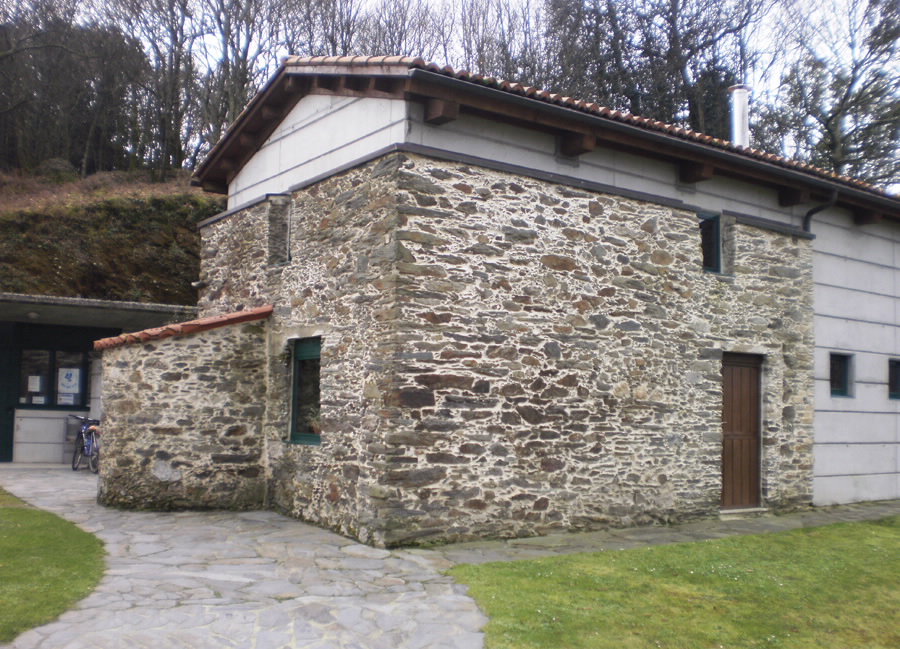
A small 16th-century masonry building associated with Hospital de Bruma. It is not impressive for its size, but seeing it means the climb is over and the stage ends just a few metres away.
Where to sleep in Bruma
Accommodation is concentrated at either end, with almost nothing in between. In A Coruña you have the hotel choice of a large city; afterwards, the first accommodation aimed at pilgrims is Albergue de Peregrinos de Sergude, in Carral, around km 20, the logical place to split the stage if you prefer to walk it over two days. Before that, Hotel A Barquiña around km 7 is useful only if you set off very late. At the end there are two options next to each other: Albergue de Peregrinos Hospital de Bruma and Albergue San Lorenzo de Bruma. Between May and October, there are few beds for a lot of people and no nearby alternative, so call before leaving A Coruña.
Where to eat and refuel
A Coruña makes things easy, so take advantage of it: you can eat very well at O’Sampaio, Restaurante A Penela or Pulpeira Maria Pita, have decent coffee at ELPUNTO coffee, grab something quick at Bo&Go, and stock your rucksack at Covirán, Gadis or Mercadona, all close to the route. Once you leave the city, things change completely: there are a few scattered bars in Carral and the villages, but they are spread out and may not be open when you need them. Set off with a sandwich, fruit and something sweet: between Carral and Bruma you will not find anywhere to eat.
Practical tips for this stage
Set off in the dark, or nearly
It is 33.6 km and around 7.5 hours of walking, without stops. If you leave A Coruña at nine, you will reach the final climb during the hottest part of the day, and Hospital de Bruma may already be full. Being on the move by sunrise saves you from both.
Take all your water with you
There are no signposted fountains along the route. Fill up in A Coruña, top up at a bar in Carral if you find one open, and do not reach km 23 with only half a bottle left: the 5.7 km climb that follows is unforgiving.
Save your legs for km 23
The 392 m of ascent between km 23 and km 28.7, at an average gradient of 6.9%, come after you have already been walking for five hours. Slow down on the flat section around Carral even if you feel strong; the stage is decided on that climb, not earlier.
Consider splitting the stage at Sergude
If you are not well trained, Albergue de Peregrinos de Sergude in Carral gives you a first day of around 20 km and a second, shorter day containing the entire climb. It is a decision best made at home rather than mid-afternoon, with tired legs.
Expect rain
This is Atlantic Galicia, and the weather can change within an hour. A lightweight waterproof, footwear that can cope with wet conditions and the lightest rucksack possible will all help: with 754 m of ascent, every extra kilo is noticeable on the final climb.
Frequently asked questions about stage 1
How long is the stage from A Coruña to Bruma?
It is 33.6 km and takes around 7.5 hours on average. There are 754 m of ascent and 378 m of descent, over terrain with constant ups and downs.
Where is the hardest climb?
Between km 23 and km 28.7. Over those 5.7 km you gain 392 m in altitude, with an average gradient of 6.9%. It is the climb to Hospital de Bruma, and it comes at the end of the day, which is what makes it genuinely hard.
Can the stage be split over two days?
Yes, and for many people it is the sensible option. Albergue de Peregrinos de Sergude in Carral is around km 20 and is the only intermediate pilgrim accommodation. The second day would be around 13 km, but would include the entire climb.
Are there fountains along the way?
No. There are no signposted fountains anywhere on this stage, so your water depends on what you carry and on finding a bar open in Carral. Take at least two litres if the weather is hot.