The stage, step by step
Leaving Lubián and the initial descent
The first kilometres lose 67 m between km 0.5 and km 2.3. At the start you have Albergue de Peregrinos, Ferreras and Estrella de Lubián; use the opportunity to set off with water and some food.
The climb to Alto de A Canda
Between km 3.5 and km 7, you tackle 263 m of ascent at an average gradient of 7.5%. A Fonte da Portela is approximately in this area. This climb defines the character of the stage: keep your stride short, your pace steady and your effort under control.
Descending towards A Vilavella
After Alto de A Canda, you descend 203 m to km 10.5. Porta Galega appears around km 11 and Albergue da Vilavella shortly afterwards, making a useful combination for a break before the second half.
Springs and the arrival in A Gudiña
The route descends again between km 11 and km 15, then climbs 124 m between km 15 and km 21.3. A Fonte da Praza Maior and A Fonte de San Pedro are in this section. The final descent brings you into A Gudiña, where you'll find Casa da Viúva, Albergue de Peregrinos and the village services.
What to see on stage 6
Alto de A Canda
At 1261 m, this mountain pass marks the official entry into Galicia. The climb is short in distance but demanding because of its average gradient of 7.5%.
Lubián
This border village between Zamora and Galicia has been a strategic crossing point for pilgrims for centuries. It's also the starting point for one of the most characteristic mountain stages on the Sanabrés.
A Vilavella
The village appears after the first major descent and provides a clear break halfway through the stage. Albergue da Vilavella is located in this transitional section.
A Gudiña
Arriving in A Gudiña marks the end of the day and the route’s consolidation in Galicia. Here you can recover, shop and organise the next stage.
Where to sleep in A Gudiña
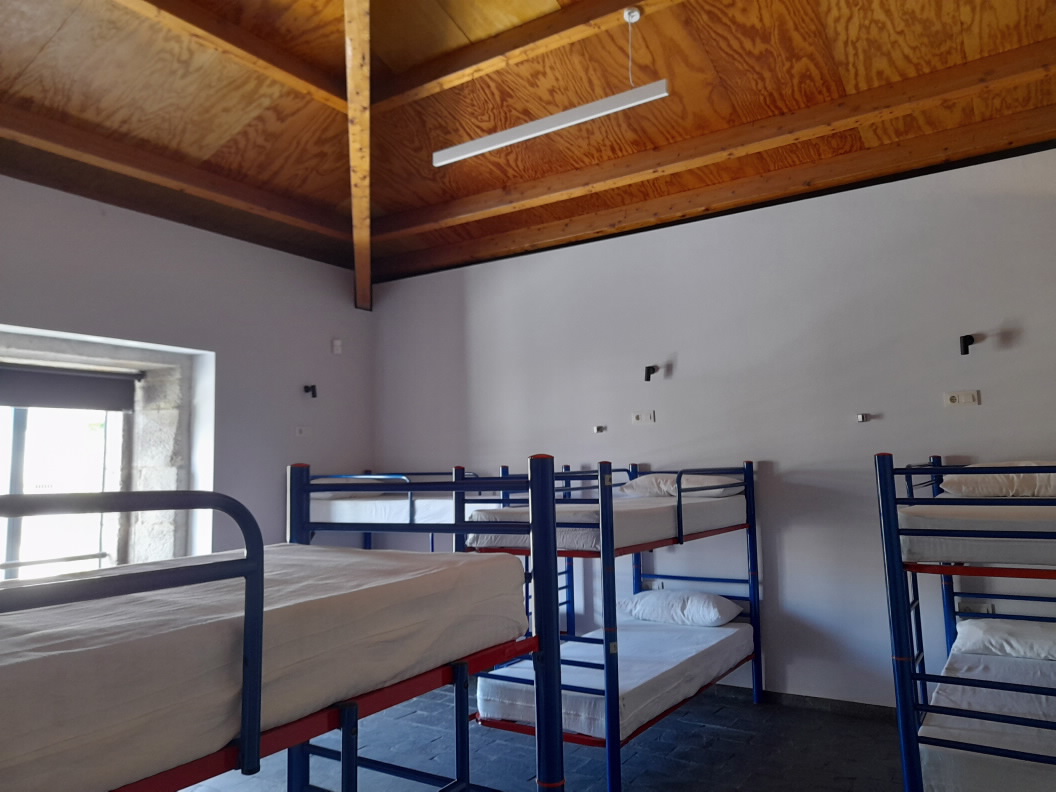
In Lubián, you can set off from Albergue de Peregrinos. Halfway along the route is Albergue da Vilavella. In A Gudiña, you'll find the municipal hostel Casa da Viúva and Albergue de Peregrinos. Accommodation is concentrated at the two ends and in Vilavella, so booking is advisable during the high season.
Where to eat and refuel
In Lubián, you have Estrella de Lubián for the start, while Porta Galega appears towards the middle of the stage. A Gudiña has the final choice, including Nicoya and Supermercado Maver. Ferreras is near the start; buy what you need there because there's no continuous supply of places between the stopping points.
Practical tips for this stage
Don't underestimate the first kilometres
The climb between km 3.5 and km 7 gains 263 m and reaches an average gradient of 7.5%. Leave Lubián slowly and find a pace you can maintain all the way up.
Keep an eye on your water
There are several signposted springs: Fonte da Paneira, A Fonte da Portela, A Fonte da Praza Maior and A Fonte de San Pedro. Even so, they may be scarce in summer, so set off with enough water in reserve.
Take a break in A Vilavella
Albergue da Vilavella and Porta Galega appear after the first descent, around the halfway point. It's a good time to eat before tackling the climb between km 15 and km 21.3.
Wear stable footwear
The day combines paths and forest tracks with significant climbs and descents. The final descent between km 21.3 and km 23.1 comes with tired legs, so take it steadily.
Frequently asked questions about stage 6
How much elevation does the stage have?
It includes 440 m of ascent and 445 m of descent, with a minimum altitude of 950 m and a maximum of 1241 m.
Where is the hardest climb?
Between km 3.5 and km 7, you climb 263 m at an average gradient of 7.5%, on the way up to Alto de A Canda.
Are there springs along the route?
Yes. There are Fonte da Paneira, A Fonte da Portela, A Fonte da Praza Maior and A Fonte de San Pedro. As they may be scarce in summer, don't leave Lubián without water.