The stage, step by step
Leaving Bruma
Leave Bruma with food and water, as the next reliable stop is a long way off. The route begins by losing 97 m between km 1.5 and km 5, following tracks and wooded areas; Casa Graña (Mesía) is very close to the start.
Woodland and small villages
The central section alternates gentle descents and climbs through meadows, dirt tracks and surfaced roads. The climb from km 8.3 to km 9.8 gains 56 m, after which the route loses height again before tackling another short rise.
San Peio de Buscás and the long stretch
The church of San Peio de Buscás is the clearest heritage stop on the stage. After that, the kilometres begin to add up: from km 16.3 to km 23.8, there is a 91 m descent, pleasant for making progress but demanding on tired legs after so many hours.
Industrial estate and arrival in Sigüeiro
The final section gains 80 m between km 23.8 and km 28. The rural landscape gives way to the industrial estate and an urban avenue; once you reach Sigüeiro, supermarkets, cafés, restaurants and several albergues appear again.
What to see on stage 5
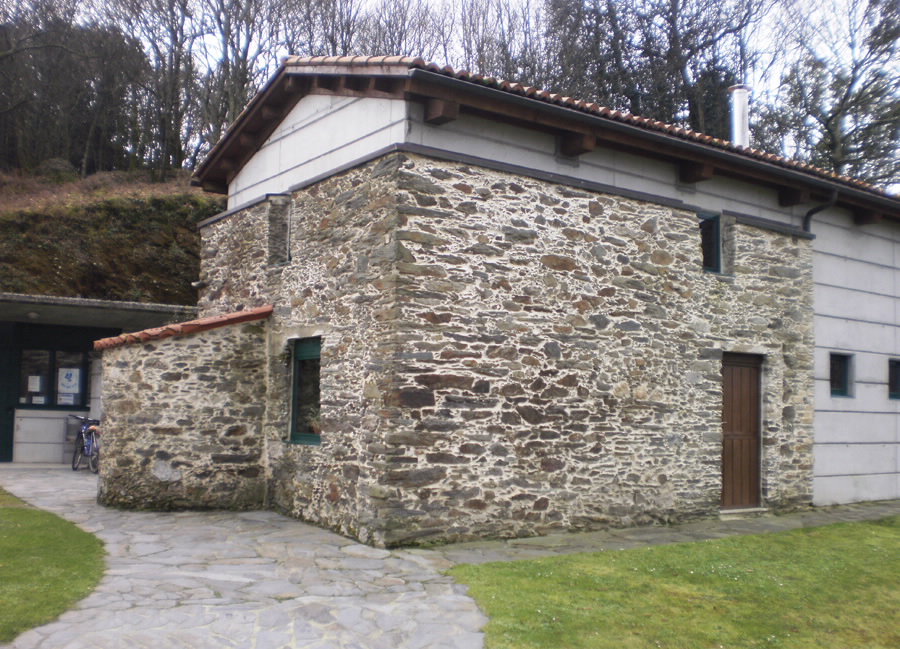
San Peio de Buscás
The church is one of the finest examples of religious art in this part of the Camino Inglés. It retains a 12th-century Romanesque base, later alterations and a polychrome image of San Paio.
Oak and birch woodland
Woodland accompanies much of the day and offers a more sheltered setting than the open areas. The landscape is quiet and rural, although the length of the stage eventually makes the tiredness felt.
Granite cruceiros
These stone crosses appear at path junctions and form part of the route's everyday heritage. They are small landmarks that help you read the landscape when the route passes through areas without services.
Where to sleep in Sigüeiro
In Bruma, you can set off from Albergue de Peregrinos Hospital de Bruma (Bruma, Mesía) or Albergue San Lorenzo de Bruma. There is also Hospedaje La Ruta along the way, although Sigüeiro offers more choice at the end: Albergue Segue O Camiño (Sigüeiro), Albergue Ultreia et Suseia (Sigüeiro), Albergue Camiño Real and Albergue de Delia. If you arrive tired, staying in Sigüeiro leaves you well placed for the final stage.
Where to eat and refuel
In Bruma, you can set off after stopping at Casa Graña (Mesía), but do not treat this as a bar-hopping route: the choice along the way is very limited and the few places are far apart. In Sigüeiro, you can replenish your supplies at Xantares do Carboeiro, Sabor Auténtico, Hostel-Restaurante-Bar Mirás or Parrillada La Cabaña, and shop at Familia, A Despensa de Sonia, Covirán (Sigüeiro) or Dia.
Practical tips for this stage
Treat it as a long stage
The 28 km and average walking time of 6.2 hours do not hide any major technical difficulty, but tiredness will accumulate. Leave plenty of time and do not delay your departure too much.
Do not rely on lunch along the way
There are few bars and almost nowhere to buy supplies on the route. Bring food from Bruma and use Fonte de Bruma and Fonte da Santiña as water references, without assuming that every fountain will be working when you pass.
Save energy for the approach
The final section gains 80 m from roughly km 23.8 and then enters an industrial area. It is neither beautiful nor particularly difficult, but it comes after many hours of walking.
Visit San Peio if it is open
The church of San Peio de Buscás is the stage's main cultural stop. If you find the door open, it is worth taking a few minutes there before continuing.
Frequently asked questions about stage 5
How long is the stage from Bruma to Sigüeiro?
It is 28 km, with an estimated average walking time of 6.2 hours.
Is it tougher than Betanzos to Bruma?
It is longer, but has considerably less total ascent: 217 m compared with 559 m on the previous stage. The main challenge is keeping enough energy for many hours.
Are there places to eat along the way?
There are few, and they are widely scattered. The sensible approach is to leave Bruma with food and do your main resupply in Sigüeiro.
Which section is the least pleasant?
The final approach through the industrial estate and urban avenue breaks up the rural atmosphere. It is short compared with the full day, but it is worth knowing that it comes after the long descent.